I'm going to open up with a picture of what I've done so far, with some discussion below...
A cast of thousands!
I've imagined this guy to be an assassin, bandit or a leader of the
bacaudae.
Source: Black Tree Designs
There's some contention as to who the
bacaudae were: either organised groups of militarised peasants or (less plausibly) the semi-militarised thugs of local strong-men outside of the control of provincial government. Kulikowski settles on "well-organised bandits who were so a general feature of Roman provincial life". Either way, they were a significant enough threat and were dealt with brutally.
Speaking of which, here are some soldiers.
Source: Gripping Beast
I'll be adding more to join them. I see them as an elite unit, or bodyguard, operating in and around the frontiers between Italy, France and Spain... more on my choice of setting another time!
Uniforms and war gear provide little distinction between "Roman" and "barbarian" armies. For the narrators of history, such as Gregory of Tours, the word "barbarian" was typically synonymous with "soldier". When Theoderic Amal (454-526) designed policy, he designed it with a classical ethnographic distinction in mind - "Goths" were typically the military elite, but they served Rome.
When I started painting these I had an alternate icon on the top - a
chi ro - which I copied from other examples.
I started to wonder why this is so popular... this is perhaps a legacy of Constantine's
labara (as seen on some coins),
and much later
the San Vitale mosaic of Justinian shows a spectacular shield with the
chi ro. As these sources are potential loaded with Eastern Imperial propaganda, I started to look around for more information.
The original shield design. A bit bleh.
What we know of shield for the armies of Late Rome are usually drawn from the
Notitia Dignitatum. This has a list of the "units" of the Eastern and Western Roman Army with a shield representing each. Peculiar shield designs for each
cohort seems to be what Vegetius describes in a passage of Book II of his
De Re Militares. The
Notitia also lists other "offices" such as political and administrative roles (e.g. the Urban Prefect of Rome). This is presumed correct for the late 4th/early 5th centuries.
But why the excess of
chi ro shields in the tabletop armies of Late Antiquity? I don't really have an answer, but they look nice and are probably easy to fit onto your miniatures. Again, the iconography from coinage and art is another source, but may be somewhat misleading.
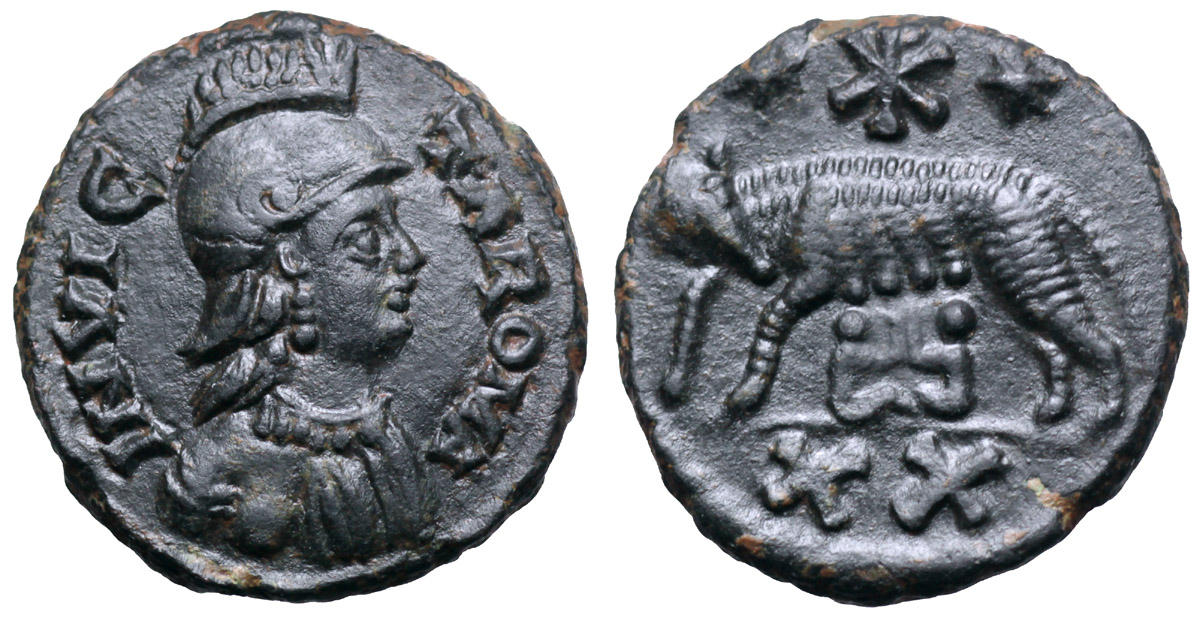
Further down the track we see that, in the West, Classical iconography presented alongside more contemporary Christian icons like the coin of Athalaric minted in Rome below. The scene above harks back to the myth of Romulus and Remus, still in popular memory in the early 6th Century. Note that bronze coinage probably had a different audience and purpose than the gold
Victoria coinage of the period. But every decision made when designing and minting coins is
intentional. It can communicate an idea, identity, quality assurance, authority, or serve as an administrative measure. Can we consider shields in the same way?
A bronze coin of Athalaric from the mint at Rome.
Source: Roma Numismatics Ltd, Auction IX, Lot 870
So, for me, it wasn't a stretch to play around with shield designs.
I've come across some promising images of shields across the web, but will look into this more for another post.
FURTHER READING
Kulikowski, M. (2010)
Late Roman Spain and Its Cities, John Hopkins