Let's talk about the "Dark Ages" a little bit.
It's a term that, over that last 50 years, has progressively fallen out of scholarly use... and rightly so. It is incredibly ill-equipped to explore this historical period. The term "Dark Ages" is a relic, and a major narrative holding this concept together is "the Fall of Rome". Yet, that is also proving to be an inadequate, and misleading, term. This concept originated in the Renaissance and throughout the Enlightenment reached its peak in Gibbons' monumental Decline and Fall of the Roman Empire (the first volume published in 1776). It persists to this day. In 1984, Demandt cited 210 reasons for "the Fall", and countless popular histories bear a similarly gloomy title.
As a metaphor, "the Fall of Rome" captures our fears for our own civilisation, and thus as myth it remains relevant. It's also alluring and dramatic, and so it also entertains us. It provides a clear and convenient distinction between eras, as well as valiant protagonists and barbarous antagonists. The never-ending battle between "us" and "them".
But, what happens when there's no "them"?
As the scholarly community have been discovering, and rediscovering, the "Fall of Rome" as a paradigm provides little in the way of historical "truth". There is no global phenomenon, or unanimous contemporary experience, that can be identified as "the Fall of Rome". Not in 376, with the crossing of the Goths across the Danube. Nor in 410, with the sack of Rome by Alaric. And neither in 476, with the deposition of Romulus Augustulus by the usurper Odovacer. "It may have been a chameleon," writes Bowersock, "but it was certainly no phoenix, because there were no ashes".
This is not to say that the turmoil, conflicts and catastrophes that define the period didn't happen. But they need to be reassessed free from the judgments and modern day assumptions. Take the Saxon advent in Britain, which I think casts a long shadow on our perceptions of the period. But the experience from person to person varied: some certainly benefitted, most probably did not. The transition from Roman to Saxon Britain (if we want to call it that) was not a smooth one, but for a variety of reasons. It is not our role to judge whether it was "good" or "bad", but we do anyway.
Another narrative, "The Barbarian Invasions" is similarly problematic. Goffart, one of my favourite scholars on the topic, points out that there has been a disproportionate amount of attention given to the "invasion" narrative in historical study. What happens when we contrast this with an "accommodation" narrative?
A question I continue to ask, and I encourage you to also consider, is "what was it about Late Roman society that allowed barbarians to enter, contribute, but also rise to the highest authority?".
What, in your mind, makes it inherently "better" or (more likely) "worse" than what came before? Is this an assumption, or is it based on "the facts of history"?
Another narrative, "The Barbarian Invasions" is similarly problematic. Goffart, one of my favourite scholars on the topic, points out that there has been a disproportionate amount of attention given to the "invasion" narrative in historical study. What happens when we contrast this with an "accommodation" narrative?
A question I continue to ask, and I encourage you to also consider, is "what was it about Late Roman society that allowed barbarians to enter, contribute, but also rise to the highest authority?".
What, in your mind, makes it inherently "better" or (more likely) "worse" than what came before? Is this an assumption, or is it based on "the facts of history"?
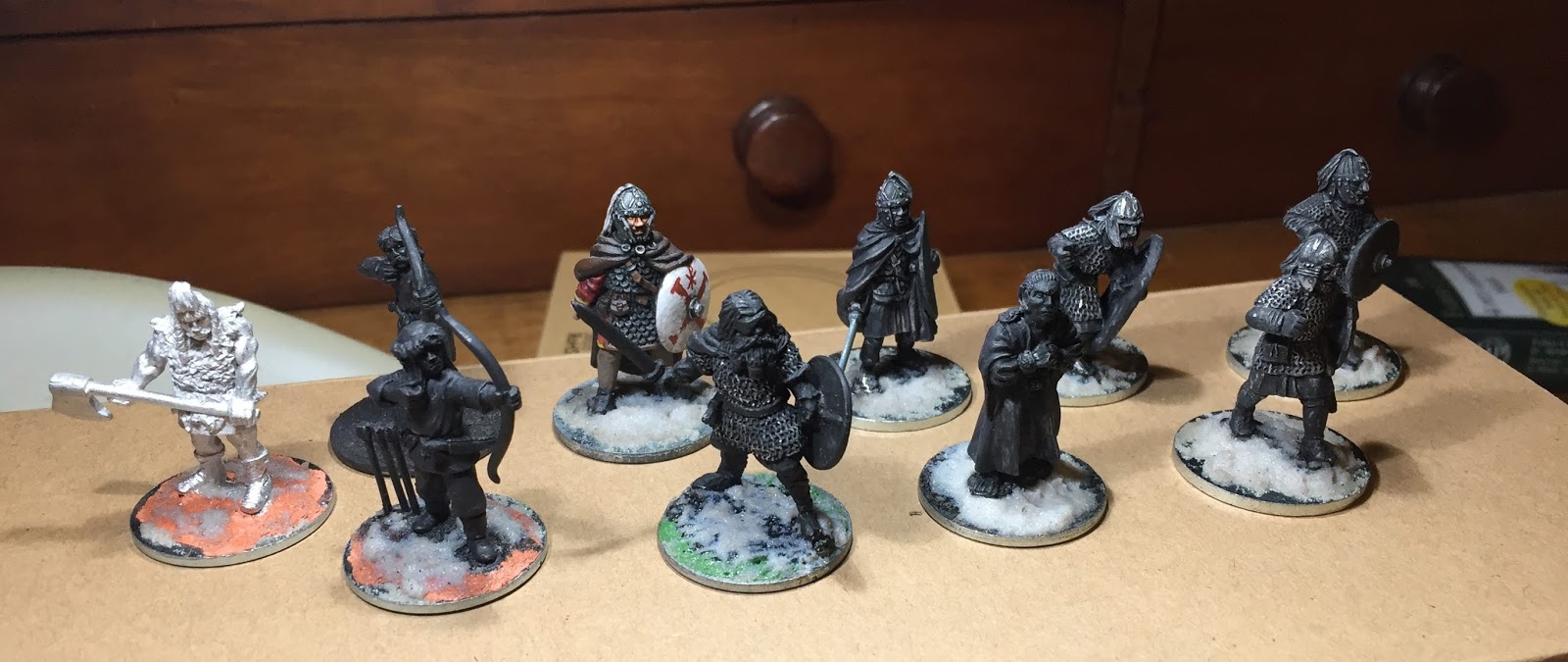
I believe that the "Dark Ages" persists in wargaming for similar reasons described above. The narrative, specifically of dramatic conflict amidst a backdrop of apocalyptic destruction: the bread and butter of wargaming. It's also incredibly convenient when you have the good guys, the bad guys, and they have homogenous (often ethnic) identities.
The question is: does that have to change?
In short, yes. Unless you're okay with propagating pseudo-historical narratives and ethnic stereotypes for the sake of entertainment.
But how?
That's a question for another blog.
Vale!
REFERENCES & FURTHER READING (AND LISTENING)
Bowersock, G.W. (1996) “The Vanishing Paradigm of the Fall of Rome” in Bulletin of the American Academy of Arts and Sciences, Vol. 49, No. 8 (May, 1996), American Academy of Arts & Sciences: 29-43
Carr, E.H. (1961) "The Historian and His Facts" in What Is History?, Cambridge University Press
Demandt, A. (1984) "210 Reasons for decline of Roman Empire" in Der Fall Roms, Beck
Goffart, W. (1989) "The theme of 'The Barbarian Invasions' in Late Antique and Modern Historiography" in Rome’s Fall and After, The Hambledon Press
Wyman, P. (2018) The Fall of Rome Podcast
Bowersock, G.W. (1996) “The Vanishing Paradigm of the Fall of Rome” in Bulletin of the American Academy of Arts and Sciences, Vol. 49, No. 8 (May, 1996), American Academy of Arts & Sciences: 29-43
Carr, E.H. (1961) "The Historian and His Facts" in What Is History?, Cambridge University Press
Demandt, A. (1984) "210 Reasons for decline of Roman Empire" in Der Fall Roms, Beck
Goffart, W. (1989) "The theme of 'The Barbarian Invasions' in Late Antique and Modern Historiography" in Rome’s Fall and After, The Hambledon Press
Wyman, P. (2018) The Fall of Rome Podcast