Showing posts with label manufacturers. Show all posts

Wednesday, April 29, 2020

Painting and building update - Christian sanctuary and some fighters

Salvete omnes!

After my last post I was itching to get to work on the small church from the Zegaani monastery site. So, during a break from my research I started playing around with the measurements and drew a couple of walls.

So far, so good...

I figured the entry would probably be a little taller and skinnier than a normal figure, although in hindsight I realised it could just as easily be a squeeze to get in.

I'm glad I went with my first instinct, though, as that left enough room to place a based figure in the vestibule (I think that's what you call the little antechamber at the entrance). Here are some progress shots:


The plan is to have either an altar or reliquary in the chancel/alcove and relatively clear space in the main area. This will all be done up with an interior, including frescoes, and detachable roofs. I just bought some styrene JTT Spanish tiles online, they look like this:
Excuse the white space, the photo came like that...

I've tried using corrugated cardboard in the past and wasn't 100% happy with it. I ended up buying a Hirst Arts pantile mould but they're a bit big for 28mm (but perfect for my Flintloque buildings). It's on its way, along with a Renedra plastic wattle outbuilding, hopefully here soon.

To wrap it up, the exterior will be weather a little bit, but nothing like that photos of what it looks like now! I imagine it being quite useful in the scenarios I have planned... a place to raid or defend from raiders, or perhaps a place to seek sanctuary (not always guaranteed to work).

I have also painted a couple of miniatures, although they aren't fully based yet. Here they are:

Saxon archer, Eureka and Viking, BTD... what is that helmet?!

One is a Saxon archer from Eureka, the other a Viking from Black Tree Design. I'm not too fussed about the ethnic labels, as you probably know (if not, read my earlier posts!). They're fighting men and that's good enough! 

As for rules, I'm looking at Pulp Alley to start out. I bought the first edition a long time ago, and just purchased the solo module. I know there's a second edition out, but will try these first. You can field small groups of 5 or 6 figures to about 15... although the more numerous the less well-trained they are. This gives me enough to play around with for narrative games to decent skirmish battles.


Anyway, I've gone on long enough now - thanks for reading!

Friday, April 24, 2020

Painting update - bacaudae, soldiers and more!

I'm going to open up with a picture of what I've done so far, with some discussion below...

A cast of thousands!

I've imagined this guy to be an assassin, bandit or a leader of the bacaudae.


Source: Black Tree Designs

There's some contention as to who the bacaudae were: either organised groups of militarised peasants or (less plausibly) the semi-militarised thugs of local strong-men outside of the control of provincial government. Kulikowski settles on "well-organised bandits who were so a general feature of Roman provincial life". Either way, they were a significant enough threat and were dealt with brutally.

Speaking of which, here are some soldiers.


Source: Gripping Beast

I'll be adding more to join them. I see them as an elite unit, or bodyguard, operating in and around the frontiers between Italy, France and Spain... more on my choice of setting another time!

Uniforms and war gear provide little distinction between "Roman" and "barbarian" armies. For the narrators of history, such as Gregory of Tours, the word "barbarian" was typically synonymous with "soldier". When Theoderic Amal (454-526) designed policy, he designed it with a classical ethnographic distinction in mind - "Goths" were typically the military elite, but they served Rome.

When I started painting these I had an alternate icon on the top - a chi ro - which I copied from other examples. I started to wonder why this is so popular... this is perhaps a legacy of Constantine's labara (as seen on some coins), and much later the San Vitale mosaic of Justinian shows a spectacular shield with the chi ro. As these sources are potential loaded with Eastern Imperial propaganda, I started to look around for more information.

The original shield design. A bit bleh.

What we know of shield for the armies of Late Rome are usually drawn from the Notitia Dignitatum. This has a list of the "units" of the Eastern and Western Roman Army with a shield representing each. Peculiar shield designs for each cohort seems to be what Vegetius describes in a passage of Book II of his De Re Militares. The Notitia also lists other "offices" such as political and administrative roles (e.g. the Urban Prefect of Rome). This is presumed correct for the late 4th/early 5th centuries.

But why the excess of chi ro shields in the tabletop armies of Late Antiquity? I don't really have an answer, but they look nice and are probably easy to fit onto your miniatures. Again, the iconography from coinage and art is another source, but may be somewhat misleading.

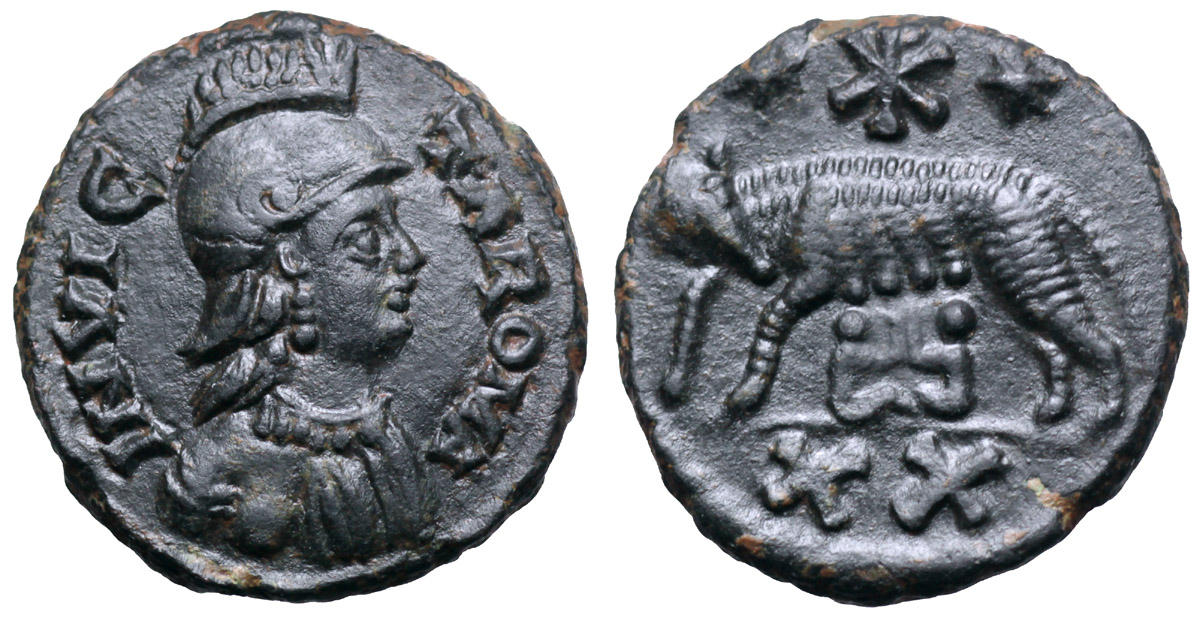
Further down the track we see that, in the West, Classical iconography presented alongside more contemporary Christian icons like the coin of Athalaric minted in Rome below. The scene above harks back to the myth of Romulus and Remus, still in popular memory in the early 6th Century. Note that bronze coinage probably had a different audience and purpose than the gold Victoria coinage of the period. But every decision made when designing and minting coins is intentional. It can communicate an idea, identity, quality assurance, authority, or serve as an administrative measure. Can we consider shields in the same way?

A bronze coin of Athalaric from the mint at Rome. 
Source: Roma Numismatics Ltd, Auction IX, Lot 870

So, for me, it wasn't a stretch to play around with shield designs.

I've come across some promising images of shields across the web, but will look into this more for another post.

FURTHER READING

Kulikowski, M. (2010) Late Roman Spain and Its Cities, John Hopkins

Sunday, April 19, 2020

Eadmund Blaccadicus

Today I got to fulfil a goal that has been brewing for some time!

Eadmvnd Blaccadicvs, bastard least favourite son of a British warlord (and a Saxon mother), who has been exiled sent on a pilgrimage to Rome to get him out of the way enrich his education and hopefully die there..


You might have noticed him in my previous post, he's one of the figures from the Gripping Beast Arthurian Heroes set. He has had a plastic sword added, as I found the original pose a little passive.

I made up the device on his shield, but drew some inspiration from the Notitia Dignitatum.


Source: http://lukeuedasarson.com

Well, it's a little bit of a stretch, but I had a lot of fun and look forward to finding a suitable Baldric to accompany him. But for now...

Salve, do you know the way to Rome?

Saturday, April 18, 2020

On the workbench - April

This is what I've got planned for April. These figures have been sitting around for years, so it's nice to finally get to work on them. I've been a bit of a stickler for miniature figure sizes in the past, but must be mellowing with age or something.


They’re based on washers, with a little bit of filler or clay to even out the surface, and some pumice paste for texture. For metals, like the chainmail on a few figures, I gently scrape away the undercoat (black gesso) with a hobby knife.

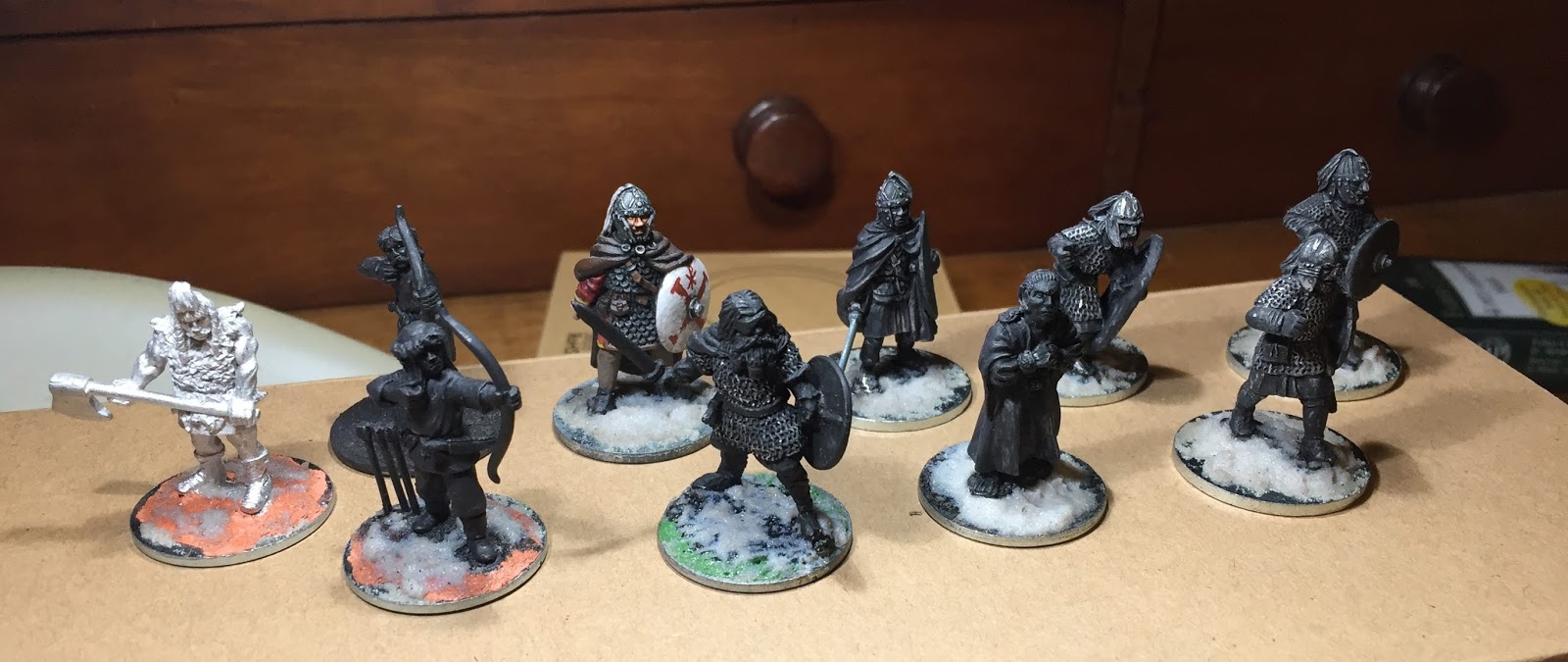
Here's a rundown of manufacturers (l to r):

Eureka Miniatures: one of Beowulf’s companions (who seems to be a stereotypical representation of a Frank), a Viking and a Saxon archer. These are really nicely sculpted by Alan Marsh, with lovely details.

"Phwoar! Check out that bloke on the left with the furs - he must be a barbarian, yeah?"
"Nah mate, that's Lucius - he just came back from a holiday in the Rhineland."

By the 5th century it seems that warriors of the period had abandoned this peculiar style of dress, although the fashion does have some precedent in literary sources. I wonder if he might instead serve better as a lumberjack? I'm still looking for reliable information on fashions of the time (but this looks promising).

Black Tree Design: The figure in the centre has had a bit of work done. I added an eye-patch, short cape, sword and shield to the base figure. Possibly a little dagger hanging from his belt, too. I see him as a kind of soldier-of-fortune or other roguish type. I'm not sure what happened to retired warriors in the 5th Century... I'll see what I can dig up.

Crusader Miniatures: Purchased for a Gladiator project that flopped spectacularly, I’ve kept this fellow for use as a senator, parvennu or other aristocrat, all whom continued to have an important role in Roman society in the 5th and 6th centuries.

Gripping Beast: Do these need any introduction? The heavily armoured soldiers in the back row are from the Arthurian and Late Roman ranges. Although intended for games set in Cornwell’s Warlord trilogy, they’ll likely see action across the Pond instead (I'll do a post on the where and when soon).

All these figures fit nicely alongside each other, if you’re not too picky, although the sweeping chronology might lead to a few anachronisms. But, nothing that a weapon swap here and there can’t address.

You'll notice that I'm a little wary of using homogenous "ethnic" titles. There's significant debate around this practice which I'd like to go into from a wargaming point of view as we go on. The short version is that when we use terms like Goths or Franks, we are usually referring to the elite minority, and not a homogenous group that identifies ethnically with that term. A term like Germanic, which even more monolithic, is right out (unless we're discussing languages, which we probably won't).

Shocking, I know - what will all those Saga players do now?

I look forward to having these painted soon, and I can already see a few scenarios brewing.

Vale!